

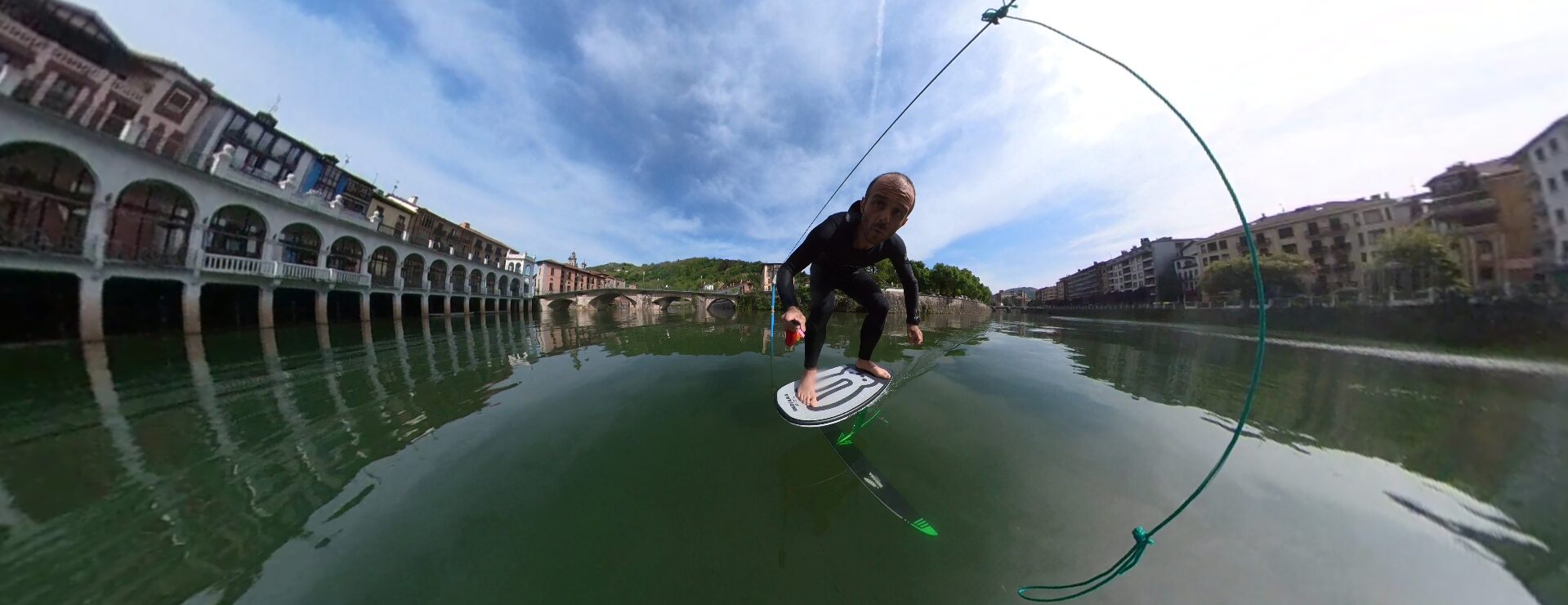
If you already know how to pump foil, the easiest thing to do is a dock start, rock start, dead start, or drop start, and then stand up on the board and head out to the waves. If the waves are coming in from where you’re starting, you’ll need to have your starting position well-chosen because, for example, it’s not the same to do a drop start or rock start on flat water as it is on water that’s constantly rising and falling.
Ideally, you should start with waves (waves that haven’t broken yet) using a relatively large foil. I started with a Gong Sirus XL for small waves, and a Sirus L or Curve H XXL for slightly larger waves that are starting to break.
You can use the same board you use for pump foiling; this will give you much more agility to get to the waves or connect with waves than with your own surfboard. The downside is that paddling back out is a bit harder, but I think it’s worth it.
If you’re going into an area with breaking waves that have some power, I recommend using a leash. It’s a bit annoying at first, but if you fall, the foil could be dragged far away by the whitewater and hit rocks, or worse, hit someone. If you have a pumpfoil board without a leash, you can improvise something similar to what’s shown in the video.
A common beginner mistake is trying to catch a wave that’s ahead. If it’s small and you’re going fast, it’s possible, but more often than not, you’ll lose lift right at the crest and fall into the water, so always try to catch the waves that are coming ahead.
At first, the easiest thing to do is pump the wave a little to the side so that it moves faster than you and catches you gradually.
When the wave catches you hard, if you’re using a large foil, it’s easy for the foil to break out of the water. With practice, you’ll learn to anticipate this and put weight on it with your front foot to ride the wave without it breaking out.
Getting off one wave to connect with another is tricky at first. We tend to come out slowly and with little speed, which can cause us to get stuck, so be careful and wear a helmet and impact vest. The key is to build speed before leaving the wave, either by riding down the wave first or by pumping and turning quickly to get perpendicular as soon as possible.
Crossing waves to connect with the next one is usually quite intuitive; it’s about pumping and aligning the upward movement of the pump with the crest of the wave.
Another common mistake is riding the wave too far until the foil touches the bottom. If it’s sand, it’s not a big deal; the foil will slow down and you’ll land cleanly in the water. But if there’s a rocky bottom, you always need to leave plenty of room.


