A few more details:
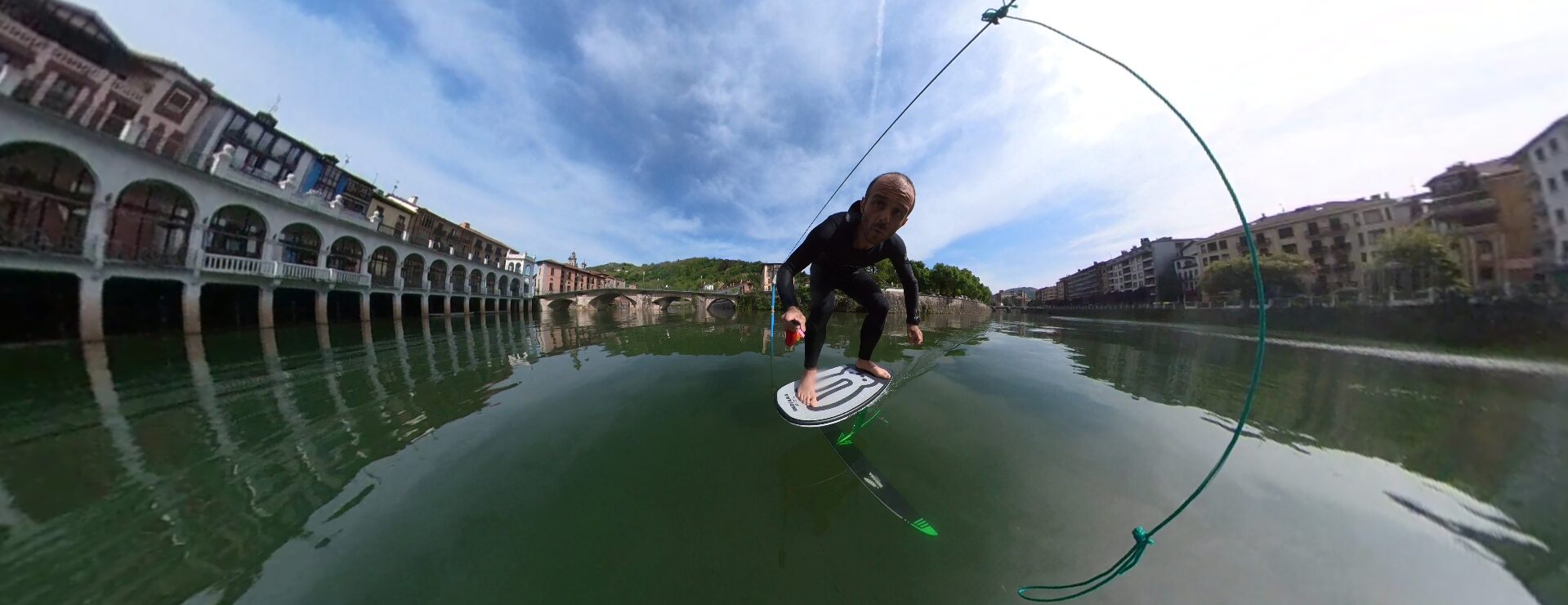
Try to keep the foil as close to the water’s surface as possible.
The less water covering the foil, the less friction it experiences. You’ll notice immediately how much lighter it is when the foil is high and how everything seems to struggle when it’s low. This is easy to say, but sometimes it’s too much effort to keep it high all the time and constantly monitor its height. So, just practice being high from time to time. Some people use a short mast of 60 or 65 cm to force themselves to stay high, but I think this can be confusing if you also do other pumpfoiling techniques besides long-distance riding.
Plug in a straight line
If we’re turning, we’ll lose focus on efficient pumping. We’ll have to accelerate our pumping to gain speed before the turn. We’ll lose some balance in the turn and waste energy correcting it.
If you want to optimize your pumping, the best thing to do is to pull straight (or almost straight) lines. Find a place where you can walk as far as you can, like a creek or a lake with a path along the shore. If you have to swim back, you’ll lose the desire to go far and you’ll tire quickly. This will also give you visual motivation during the ride, as you see yourself surpassing places you previously stopped.
Also, if you pump in circles, your mind will be tempted to give up every time you pass near the dock, and you’ll practice less, push less, and find your true physical limit more difficult.
Looking through my playlists of record-breaking videos, it turns out that I almost always end up getting tired right next to the dock, and it’s not a coincidence. Your brain will tell you that you can’t go on anymore, so when you get to the dock it gives up, even though you could probably have continued a little longer, giving it your all.
The Wind Has a Big Impact
Even a light breeze, barely enough to call it wind, will greatly affect your pumping. You’ll feel light and agile with the wind, but as soon as you turn around, it will seem like nothing is working anymore, as if the water is creating more resistance. So, when you’re attempting a record, always try to go with the wind.
The current
Believe it or not, if you take a river with a gentle current against the current, you’ll perform much better than with it (slower, but with less effort). On the same day, in the same place, I’ve noticed that I cover twice as much ground (in twice the time) against the current as with it.
I think this might be due to the previous point: for the foil to maintain the same relative speed with the current in the water, you have to be traveling at a much higher speed on the surface, meaning the external air resistance is significantly greater.
Water temperature
The colder the water, the denser it becomes, and therefore, the more resistance it creates on the foil. So, you’ll always perform a bit better in the summer. In saltwater, buoyancy is also greater, so you’ll always perform slightly better in saltwater than in freshwater. However, these factors aren’t huge, so it’s no excuse to stop pumping in winter.
Change your spot
Despite the theoretical advice, you’ll need time and practice to improve, and therefore, you’ll need motivation. One way to find motivation is to change your spot. By changing, you’ll find new challenges, places to aim for, starting points, and different wind and current conditions.
Practice other disciplines
If you only focus on long runs, it can be a bit frustrating, and your progress will seem slow. Practice other pumpfoiling styles as well: freestyle, wakethieving, waves, speed… All of this will complement and improve your pumpfoiling technique and will also help you with long runs.
Switch to a smaller stab
I already mentioned this at the beginning, but it’s worth repeating: the smaller stab will give you more lift and less drag in the water. While you might lose some balance at first, it’s just a matter of practice.
Return to the index of tutorials