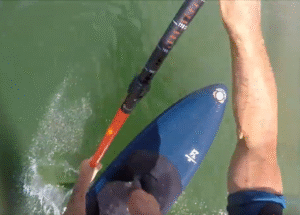
Wakethieving, or wakefoiling, involves surfing the waves created by boats using a foil. These waves are usually easier than ocean waves, making it a good way to get started.
If you have your own boat, you can start from a rope, but otherwise, you’ll need to start from a nearby dock, or use a drop start or dead start, and pump your way up to the boat’s wake.
On small and medium-sized boats, the strongest wave is usually the first one generated by the boat’s stern. On larger boats, they often say the second wave is the best, but I haven’t been able to test that yet. Initially, you should stick to waves a little further from the boat for safety, and gradually move closer to the first one as you gain confidence.
You have to keep in mind that waves are stronger the closer they are to the surface, so if the wave is small, having a high mast is important. It’s not as noticeable in ocean waves, but it makes a big difference on ships.
The first thing you’ll learn is that if you try to ride a wave from behind, you’ll lose lift as you approach the crest. So, unless the wave is very small or you’re traveling at high speed, you probably won’t be able to ride it. Therefore, there are three ways to get ahead of a wave:
- Overtake in the middle of the boat where there are no waves. Turbulence often develops and can knock you over, so it’s best not to go right in the middle but rather around the corner where the wave begins.
- Overtake when there is speed. If the wave isn’t very big and you’re going much faster than it, it’s possible to cross it in one swift motion.
- Overtake by looking for gaps where the wave is smaller. Sometimes the waves break up a bit in the middle; you can look for these gaps to slip through.
- Move away from the boat to the side where the waves are smaller.
You can see some examples in this video:
Once you’re on the wave, it’s all about practice to get more comfortable. Over time, you’ll see that simply changing the pressure on your front or back foot allows you to raise or lower the foil.